

As far as we know, there are two paths leading to the Juan Curí waterfall. Both cross private land and require payment of an entrance fee. In this article, we’ll only be talking about the Parque Ecológico Juan Curí trail, which we took ourselves. We have not tested the other route.
In brief


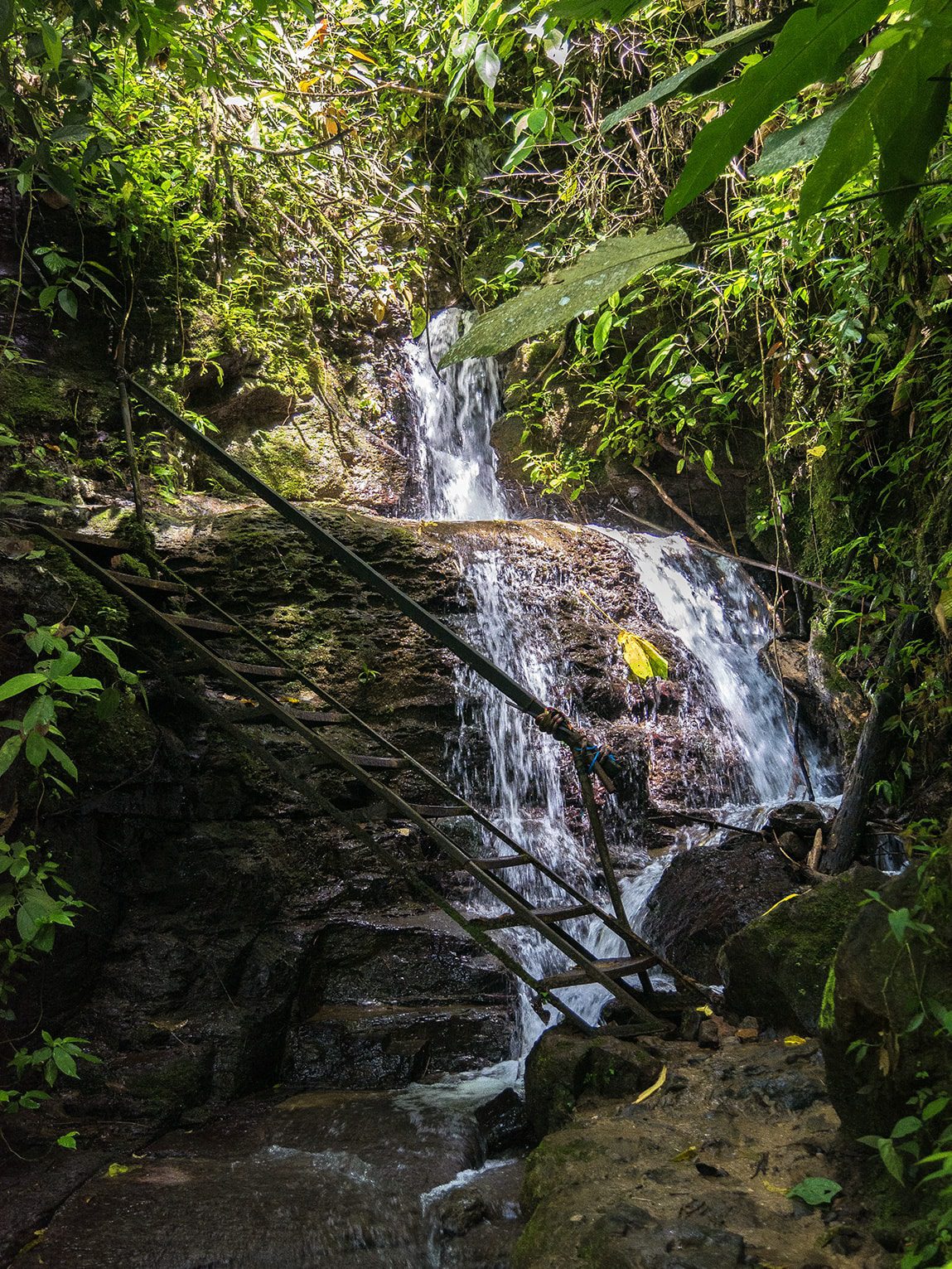

The Juan Curí waterfall, located in the heart of the Santander department not far from San Gil, is one of the region’s most impressive natural treasures. With its 200-metre drop of crystal-clear water (in several steps), this waterfall plunging into the canyon of the Juan Curí river offers a powerful yet soothing spectacle, attracting adventurers, photographers and ecotourism enthusiasts alike.
The path leads through primary forest, where lush tropical vegetation and exotic birdsong accompany every step. Once you reach the lookout, the crash of water over rocks creates a refreshing mist, inviting you to contemplate the perfect union of nature and landscape.
Cascade Juan Curí
- County: Santander (Andes)
- Height: 130 m + 70 m
- Altitude: 1,300 m
- Ecosystems: sub-Andean forest
- Climate: hot humid climate
- Direct access from San Gil
Our opinion: an easy walk to a beautiful waterfall ★
Colombia is full of waterfalls – hundreds, maybe even thousands – and Santander, which is crossed by the Andes, is no exception. Among them, the Juan Curí waterfall is undoubtedly the best-known in the region. It leaves a very positive overall impression, provided you know what to expect. First of all, it is located in a private park, the Parque Ecológico Cascadas de Juan Curí, and admission is charged. The well-maintained access path is easy for anyone with a little walking experience. You advance through dense tropical vegetation, lulled by birdsong: a lovely immersion in nature. Once you reach the foot of the waterfall, the cool mist and the sound of crashing water create a pleasant atmosphere. In high season, the place can get busy – especially with groups abseiling down the waterfall. It may not be the most impressive waterfall in the country, but it has other assets: a lovely walk, the chance to swim in cool water (much appreciated under Santander’s often intense sun), and a setting conducive to a nature break. If you go with these expectations, you’re sure to have a great time.
Tourist numbers at the Juan Curí waterfall
The waterfall is the best-known and most frequented in the San Gil region. Although it doesn’t receive thousands of visitors every day, if you’re looking for peace and quiet, it’s best to go in the morning, when the crowds are smaller. And if you’re looking for peace and quiet, the best time to visit is on weekdays rather than weekends.
Climate at the Juan Curí waterfall
The region enjoys a tropical climate characterized by relatively constant temperatures and a marked rainfall pattern. Daytime temperatures hover around 25°C (in the shade), with lows around 15°C. Rainfall is abundant throughout the year, averaging 4,282 mm per year. The rainy season peaks between April and August, with monthly rainfall ranging from 418 mm (in April) to 498 mm (in July). The driest period is from December to February, with monthly rainfall ranging from 168 to 229 mm. Although it can rain all year round, showers are generally heavy but relatively short, making for generally fine days.


Parque Ecológico Juan Curí
An Andean oasis within easy reach of San Gil
Perched between 1,100 and 1,300 m above sea level, the Cascades de Juan Curí Ecological Park stretches along the eastern slopes of the Cordillera Oriental de los Andes, 22 km southwest of San Gil (Santander). Accessible in 30-40 minutes from downtown San Gil (by bus, colectivos or car), the route winds through coffee plantations, meadows and small tributaries of the Río Fonce before reaching the park’s entrance gate, well signposted.
This privileged position, halfway between valley and Andean plateau, offers both easy access for day trips and a starting point for longer expeditions in the Charalá region.
A jungle climate and unsuspected biodiversity
The park enjoys a warm, humid tropical cloud forest climate, with an average annual temperature of 22°C (min. 18°C, max. 28°C). Mornings are often shrouded in mist, dissolved by the sun around 9 a.m., while afternoons can be hot and humid. Precipitation is abundant (3,500-4,500 mm/year), with a peak between April and July and a slight lull from December to February.
The vegetation is divided into three altitude levels:
- 1,100-1,200 m: pre-montane forest dominated by palms, tree ferns and large heliconias.
- 1,200-1,300 m: cloud forest, rich in mosses, lichens, epiphytic bromeliads and orchids.
- Banks of the Río Juan Curí: riparian formation with wild banana trees, Asteraceae shrubs and swampy areas dotted with bamboo.
This mosaic of habitats supports exceptional biodiversity:
- Avifauna: over 120 species of birds (toucans, parrots, hummingbirds, tangaras).
- Mammals: chipmunks, agoutis and, occasionally, traces of pumas or ocelots captured by tracking cameras.
- Amphibians and reptiles: endemic tree frogs, salamanders and non-venomous snakes.
Not 1 waterfall, but 2!
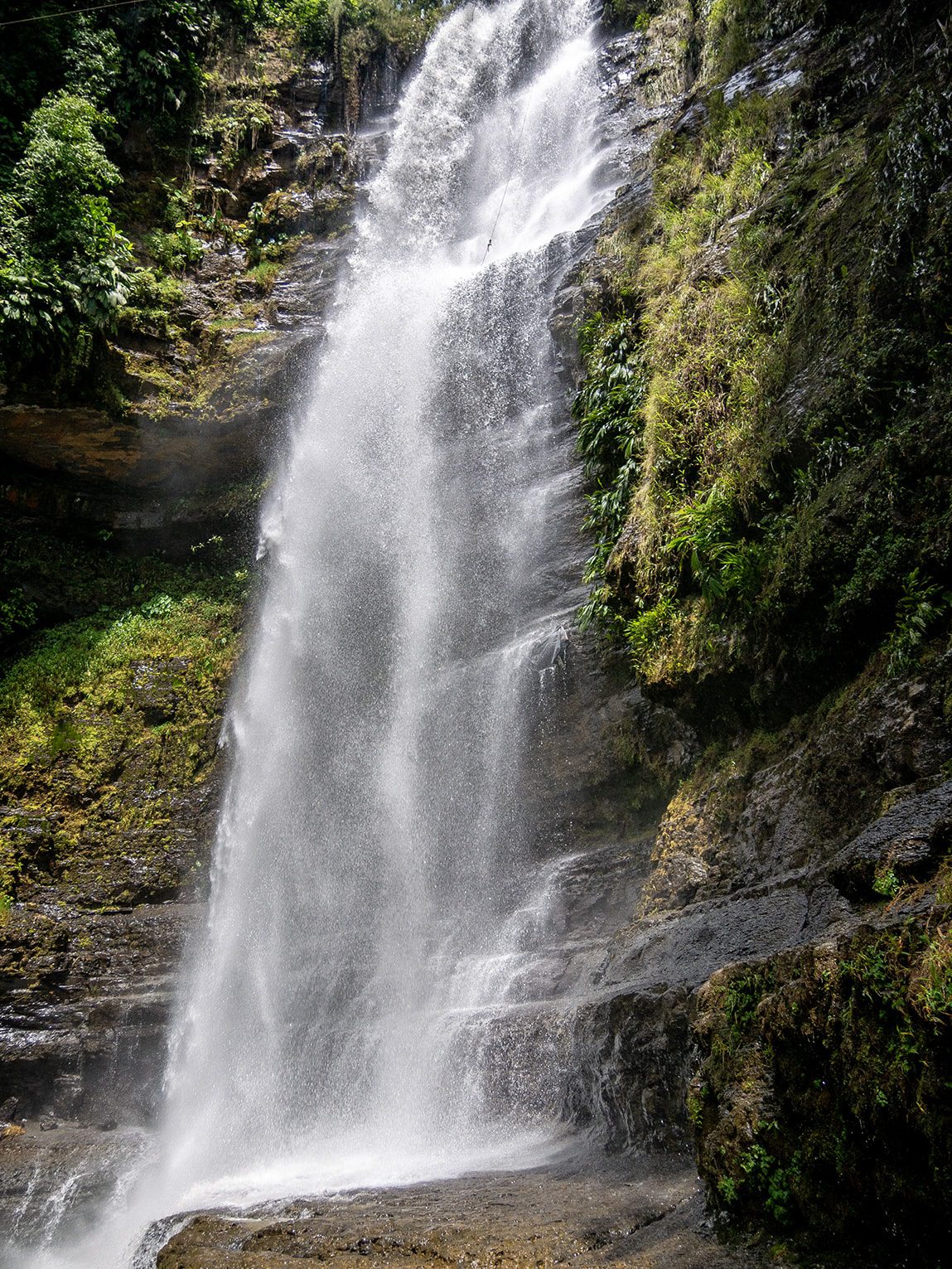
The main trail (1 km, 30-40 min, moderate difficulty) leads first to the 130 m high cascade, a body of water whose flow fluctuates from 150 L/s in the dry season to 400 L/s in the rainy season. A protected lookout, nestled among ferns and lianas, offers a side view of this liquid curtain.
Continuing on, you reach the 70 m lower cascade, whose fall crashes into a pool 15 m in diameter and 5 m deep. This is where torrentismo (canyoning) takes place, creating a refreshing mist and a kaleidoscope of droplets in the sunlight. Between the two falls, dark rock and lush vegetation follow one another in tiers, punctuated by bathing pools and water-sculpted caves.


Practical information
Our experience
It’s barely dawn, and already the sun is gently warming the air in San Gil. Perfect weather for a refreshing activity! We head for the terminalitoa small terminal just a few blocks from our hotel – not to be confused with the main terminal, located outside the city and reserved for medium and long-distance journeys.
A typical Colombian bus picks us up for a 40-45 minute journey. The road is pleasant, winding through fields and pastures, with the majestic Andes as a backdrop. Few curves, a quiet road. We keep our eyes peeled for a roadside sign indicating the proximity of the waterfalls. The stop is unobtrusive, lost in the middle of the countryside, so we have to remember to warn the driver ahead of time. Lo and behold, the famous sign appears. The bus stops. We get off, a little hesitant… Is this really the place? There’s not a soul to be seen, which leaves us in doubt.
Despite this feeling of isolation, we leave the road and take a small path towards a hut. A few meters further on, our doubts are dispelled: we’ve come to the right place. A woman, alone on the premises, is in charge of the ticket office. We decide to make do with the hiking trail leading to the waterfalls of the Parque Ecológico Juan Curí, although there are other activities available on site, at an additional cost.
The hike begins without delay. It’s more of a stroll than a real walk: accessible to anyone with even the slightest habit of physical activity. The route is neither difficult nor long: it takes only 30 to 40 minutes to reach the famous falls. Along the way, an unexpected companion joins us: a criollo dog, typical of Latin America, who adopts us for the duration of the adventure.
The trail passes through groves and, at the turn of a few clearings, offers lovely views of the surrounding mountains. Gradually, a muffled roar is heard: the waterfall is approaching. And there it is! Majestic without being overwhelming, it nestles in a setting of tropical vegetation, giving it an undeniable beauty. Near the waterfall, a Colombian – guide or lifeguard? – supervises bathing in a pozo, a natural pool accessible by climbing a few rocks. This is where we meet other visitors: a small group of four young European women. We’d come early in the morning, which no doubt explains the small turnout.
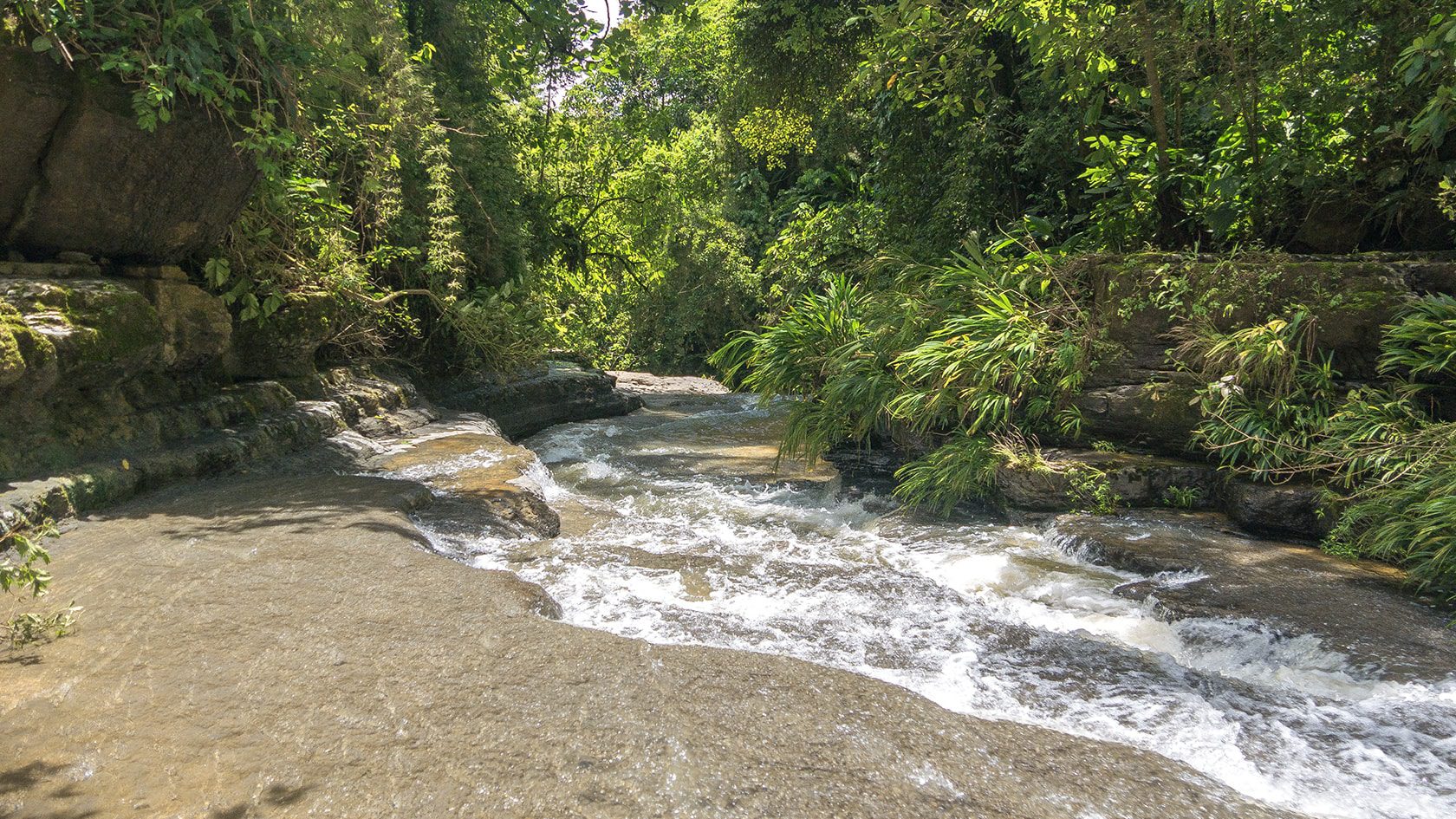
Neither exhausted nor really sweating, we look for a quiet spot to drop our stuff and dive into the water. The water is obviously icy cold, a real wake-up call in itself! The moment is pleasant, but brief: the cold quickly pushes us out of the water. We then sunbathe on the rocks. From our perch, we watch the river meander below us, cutting a tumultuous path through the heart of the Andean forest. A beautiful sight.
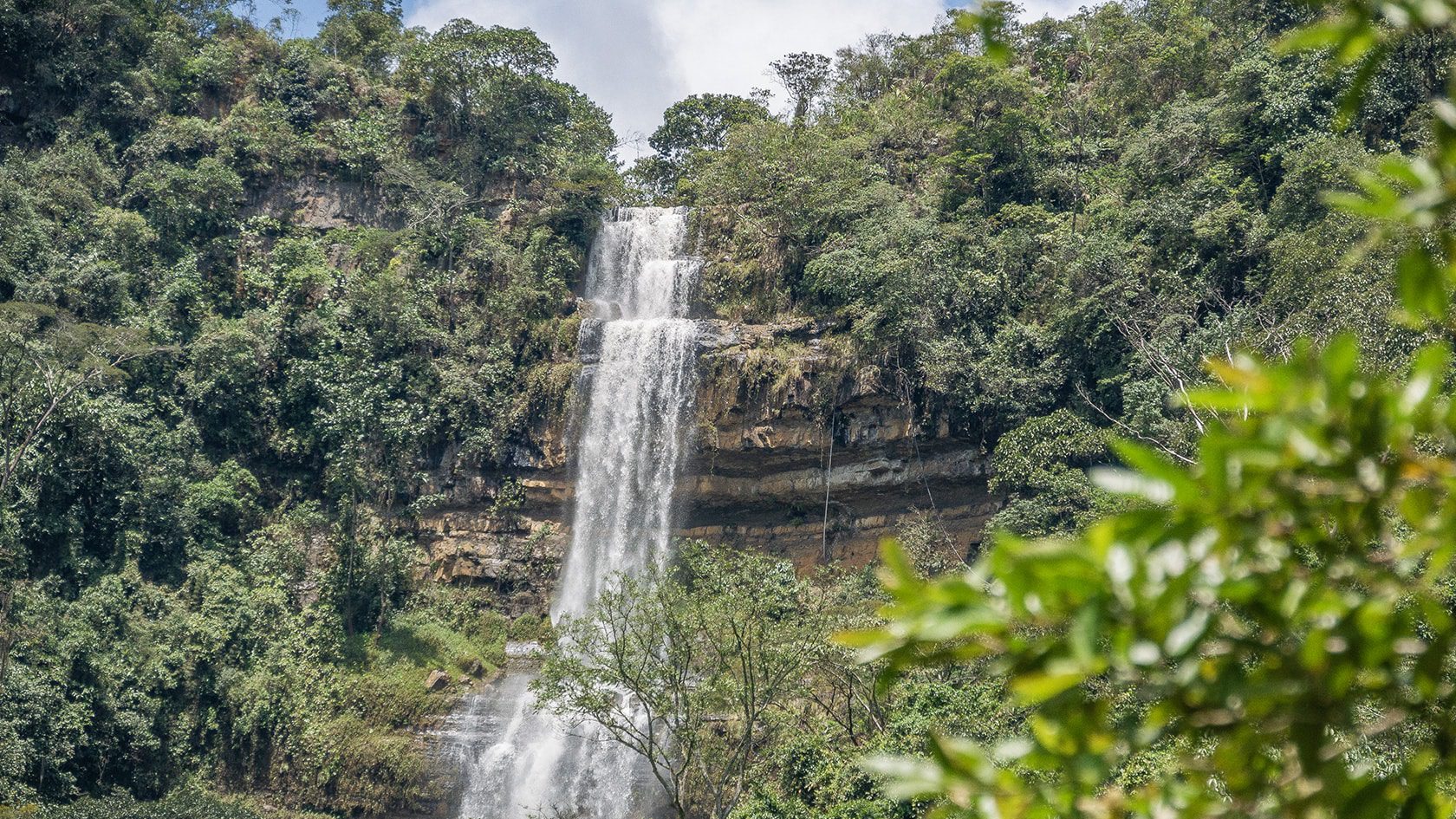
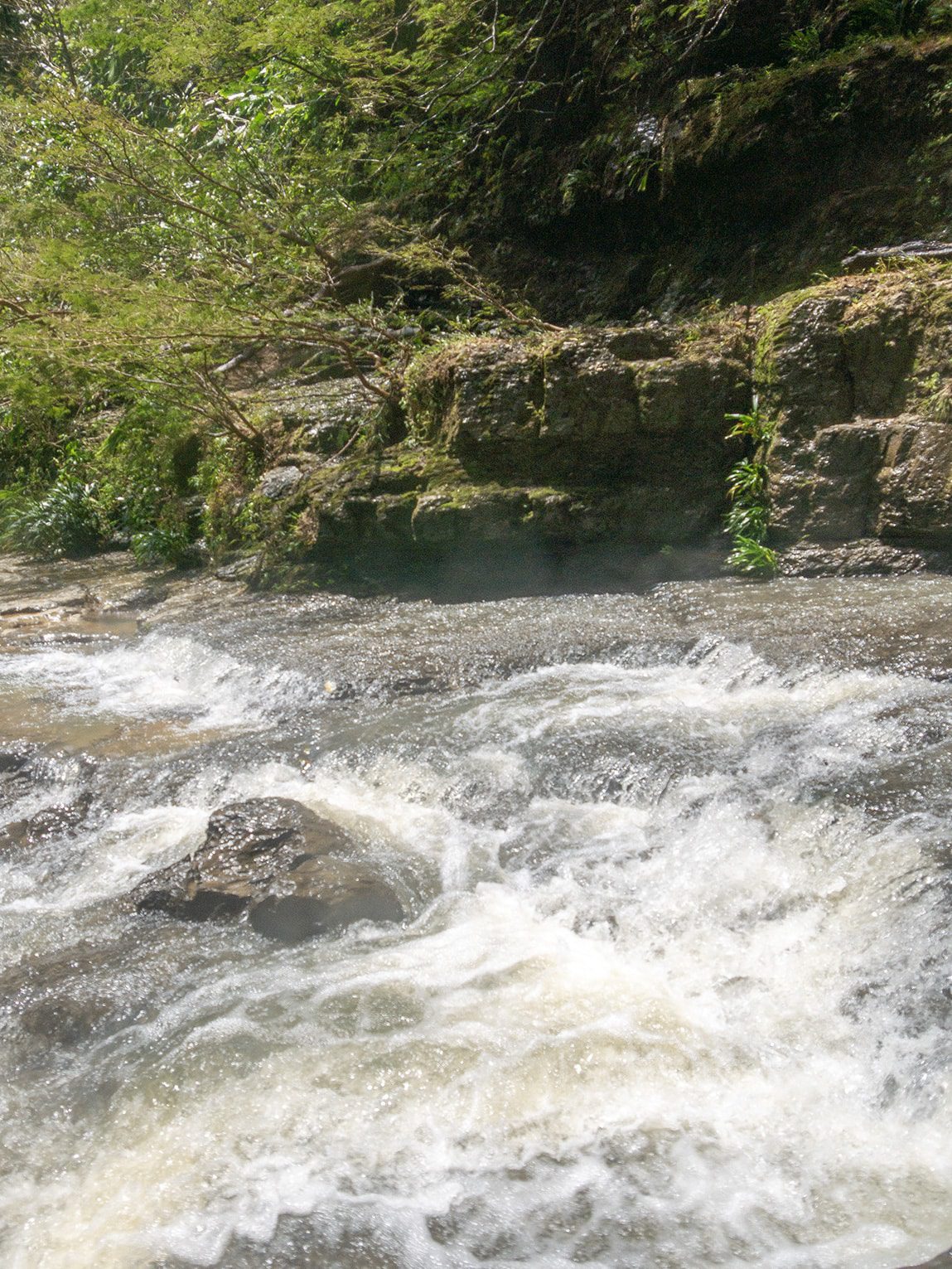
A little further on, a rope is stretched between the two banks at a point where the river is only a few centimetres deep. Obviously, we can’t resist the temptation to cross. Barefoot, we cling to the rope and progress cautiously: the rock, polished by the current, is treacherous. Once on the other side, we climb over a few rocks, gaining a new angle on the waterfall – which, surprise! is actually two falls: one 70 metres high, the other 130. Superb panorama.
We spend a while contemplating the scenery, lulled by the sound of the water alone. But we have to get going again. We turn back, still accompanied by our faithful four-legged companion, who, like an impromptu guide, accompanies us back to the park entrance. On the way, we have an unexpected encounter: a large toad crosses our path.
Now all you have to do is wait for the next bus to San Gil. Don ‘ t hesitate to ask the person at the ticket office what time it arrives. If it’s going to be a long wait, you can take the opportunity to drink an aguapanela (or any other drink) in the park’s little restaurant.
The hike to Cascade Juan Curí is therefore an ideal outing for those looking for an easy-to-organize getaway, close to San Gil, inexpensive and with no real physical difficulties.
Activities
As you might have guessed, our visit was limited to the hike to the waterfall. However, the Juan Curí Ecological Park is much more than a simple contemplation of its falls: right in the heart of the “Colombian capital of extreme sports”, San Gil, it offers a range of thrilling activities. In addition to hiking, three “adventure” packages are available for adrenaline and challenge seekers, offering a variety of activities:
1. Guaranteed thrills
- Super zip line: come close to the waterfalls as you hang from a height of 90 m over 200 m of cable.
- Classic zipline: 150 m above the 130 m waterfall for a breathtaking view.
- Rope network: descend to the ground before flying back over the falls.
- Canyoning: rappelling down a 70 m waterfall, an adrenalin-filled sport. No previous experience is necessary.
2. Balance and skill course
- Tibetan bridge: advance on two lines (upper and lower) between ropes and trunks.
- Net bridge (malla): test your balance on a grid suspended from the top of the course.
- Slackline: walking on a taut strap, like an acrobat, above the void.
- Nepalese bridge and tunnels: cross a series of suspended galleries and bridges for a continuous challenge.
3. Climbing and obstacles
- Camino de Roca: climb the “floating rocks” to reach the Tibetan bridge.
- Trunk climbing: climb vertically on unstable trunks, like a pro climber.
- Trunk ladder / extreme: challenge your strength by scaling vertical logs to outrun the “treasure keeper”.
- Reverse Via Ferrata: abseil down a wall, harness and guide included.
- Camino de la Serpiente: side climb along the wall to the “treasure keeper”.
4. Thematic exploration
- Cueva del Tesoro Guane: 15-minute visit to a cave of stalactites and stalagmites, in search of treasure.
Rates
The Parque Ecológico Juan Curí offers several activities in addition to the hike to the waterfall:
| Activities | Price per person |
|---|---|
| Hiking trails | 12,000 COP |
| Tyrolean traverse and cave – 6 activities | 80,000 COP |
| Canyoning | 80,000 COP |
| Tyrolean traverse, cave, climbing, movable bridges, etc. – 28 activities | 120,000 COP |
Booking and opening hours
Reservation
It is not mandatory to book in advance, but if you prefer to do so, here are the options available for making a reservation:
- Official website: https: //parquejuancuri.com/
- Instagram: @juancuriparqueecologico
- Facebook : Parque Ecologico Juan Curi
- Email: contacto@parquejuancuri.com
- WhatsApp: +(57) 3114893272
Opening hours
The Juan Curí Ecological Park is open to visitors at the following times:
- Every day from 08:00 to 16:00


How to get to the Cascade Juan Curí?
The waterfall can be reached by public transport from San Gil, 22 km away. If you’re in Barichara, you’ll need to take 2 buses: one from Barichara to San Gil, and another from San Gil to the Juan Curí waterfall.
The nearest airport to San Gil is Bucaramanga (BGA), 63 km away. There is no direct public transport link between the airport and San Gil. So you have to go to the Bucaramanga bus terminal to catch a bus to San Gil.
Getting to Cascade Juan Curí from San Gil
| Companies | Cotrasangil, etc. |
| Departure | Every 30 minutes or so |
| Departure point | Terminalito de San Gil (about 4 blocks from the main square) |
| Destination | Village of Charalá. Ask the driver to leave you at the “Las Cascadas / Juan Curí” stop, located between San Gil and Charalá. |
| Duration | 40 minutes |
| Route type | Direct |
| Price (one-way) | 8,000 COP / person |
To return, simply wait for a bus in the opposite direction at the park entrance.

Where to stay to discover the Cascade Juan Curí?
Just 30-40 minutes away, the small town of San Gil is a perfect base for sleeping and sightseeing. Barichara may also be an option, but travel time will be 2-3 times longer, as you’ll have to pass through San Gil again.
Here is a selection of recommended places to stay in San Gil.


Remarks
Don’t forget your bathing suit!
Don’t forget to pack a swimsuit (and towel!) if you plan to cool off in the icy waterfall.
Raincoat (poncho, K-Way)
The mountain climate is capricious and sudden downpours frequent, so don’t forget to pack a waterproof poncho or K-Way.
Suitable footwear
Avoid smooth soles, which can easily slip. Choose shoes with good grip. And be careful on wooden bridges and footbridges, which are often slippery when wet.
Suitable clothing
For good protection against the sun and mosquitoes while hiking, opt for a t-shirt or long-sleeved shirt. Don’t forget to bring a hat to cover your head and face.


