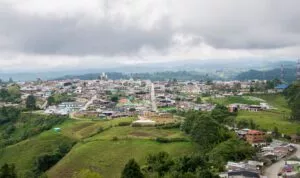
The legend of Fura and Tena is a treasure trove of cultural heritage in the regions of Cundinamarca and Boyacá, the main departments where emeralds are mined in Colombia, the world’s leading producer. Two mountains, Tena and Fura, rise majestically above the Guaquimay River, Carare or Zarbi, and according to legend symbolize the natural wealth of the region, home to an indigenous forest teeming with life. They were revered as sacred places by the Muzos Indians, bearing witness to their spiritual heritage.
Today, the region’s inhabitants pass on the captivating legend of Fura and Tena, evoking not only the appearance of emeralds in Colombia, but also the genesis of mankind. This legendary tale has its roots in Muzo mythology, a pre-Columbian civilization that once inhabited the majestic Andes mountains, and was the first to discover the precious, bewitching green stones known as emeralds.
We’re now going to tell you the tragic story of Fura and Tena, a legend we find captivating.

The origin of mankind: creation by Fura and Tena
In the beginning, when the world was still young and full of mysteries, Are, the supreme god, stood there, majestic, creator of all that was under the sky. His gaze, like an immense tilted shadow, rested on the flanks of the Great Magdalena River, crossing the immensity of space with slow, graceful flight. With each beat of his gliding footstep, mountains and valleys seemed to bow in grateful salute to their Creator.
Arriving at the river’s sacred banks, Are took a handful of earth and lovingly fashioned two idols, the Fura and the Tena. Then, with a powerful gesture, he threw them into the clear waters of the stream, where they were purified by the foam, regaining the breath of life. With them were born the first children of the human race, guided by Are’s benevolent hand.
The god taught them the boundaries of their lands, the secrets of agriculture, the art of pottery and weaving, and the courage to defend themselves against the dangers of nature. He gave them absolute freedom, and the sun, moon and stars to light their way. But above all, he granted them the privilege of eternal youth, provided their love was pure and exclusive. For any infidelity would be punished by old age and death for both lovers.
Thus were born the Muzos people, guided by the sacred teachings of Fura and Tena. Years and centuries passed, but time did not touch them; they remained eternally young and fertile. Each Muzo, at the dawn of his twentieth year, set off in search of a plot of land on which to found his home, in total freedom, his only obligation being to venerate his divine ancestors, the first beings of their world.
Thus, under the benevolent gaze of the supreme Are, the Muzos raised fertile fields from the mountains, as a token of gratitude to the first beings, Fura and Tena, who had so faithfully followed the teachings of the creator god.
Turtur, Tununguá, Pauna, Canipe, Misuncha, Quípama, Oquima, Cubache, Sacán, Terama, Corauche, Acoque, Chánares, Bunque, Ibacapí, Macaguay, Cóquira, Quipe, Chungaguta, Maripi, Muzo, Cuacha, Guaquimay, Sosque, Isabí, Miabe, Boquipí, Purí, Quibuco, Pistoraque, Coper, Surapí, Itoco, Yanaca, Ancanay, Otanche… These names resounded like so many tributes, each carrying with it the story of the Muzos’ devotion to their divine ancestors. Every field, every valley bore witness to the greatness of their respect for Fura and Tena, those beings who had so valiantly followed the path laid down by the supreme Are, making their way through hardship to the sacred waters of the Carare.

The quest: from love to suffering
Quietly, the Muzos continued their laborious existence, lulled by the rhythm of their days. After centuries of prosperity, the descendants of Fura and Tena, hit by the relentless weight of mortality, finally breathed their last.
On the western flank, where Are had once appeared, a young man of rare lineage emerged in search of a legendary flower, whose fragrance had the power to relieve all suffering and whose essences possessed the cure for all illnesses. This young man, named Zarbi, surveyed mountains, crossed rivers and climbed trees, scrutinizing every nook and cranny in search of the coveted plant. But despite his relentless efforts, the mysterious bud remained elusive, tricking him at every turn.
Dismayed by his fruitless search, Zarbi decided to enlist Fura’s help, hoping to find in her an ally in his desperate quest. With passion, he described the extraordinary properties of this coveted plant. Touched by his distress, Fura agreed to accompany him on his quest. Together, they ventured into the mountains, but as time went by, the contours of their relationship began to change, the initial impulse of compassion gradually transforming into a deeper affection.
In the heart of the jungle, while they were immersed in their quest for the mystical flower, a sly temptation presented itself: a poisonous flower, bearing death in its petals.
The accusations echoing in her conscience, Are’s words emerging from the depths of her soul, plunged Fura into deep sadness. With the weight of this guilt, she felt the marks of time settling on her being, irrefutable proof of her infidelity and the ominous harbinger of her own death.
Tena then realized that the sacred law of exclusive love, imposed by Are, had been transgressed by Fura and that their fate was sealed. Yet, by way of punishment, the unfaithful woman had to endure a most cruel punishment: holding the body of her deceived husband on her lap for eight days, watering the remains of the innocent victim with her tears, and thus witnessing, in unbearable pain, the macabre process of human decomposition.

The birth of emeralds
Meticulously sharpening his bludgeon like a dagger, Tena lay on Fura’s lap, driving the stake through his heart. Blood gushed from the wound, dyeing Fura’s feet with a crimson blanket, a liquid, undulating sea, as her spirit began its journey towards the sun, that dazzling star given by Are to breathe life. Before disappearing forever, however, a final impulse of vengeance overcame her.
In a faraway land, he transformed Zarbi into a bare rock, destined to be scourged by the rays of the sun, the firmament of the Muzos.
Even petrified, Zarbi fought back, defended himself, took revenge. He tore his insides apart, turning the blood that had fueled his life into a raging torrent. He tore up the weeds, flooded the Muzos’ land. But as he gazed at Fura, holding Tena’s inert body in his lap, the most tumultuous waves broke loose, crashing against the lovers, isolating them forever. They froze, petrified, two colossi sculpted by the tumultuous waters, facing each other eternally, separated by the river’s impetuous current.
The pain that gripped Fura was immeasurable. Those few hours when she held Tena’s inert body in her lap seemed stretched to infinity, each moment charged with age-old bitterness. Her remorse, her tears, became living elements, forever inscribed in the Muzos story. Her cries of despair, tearing through the silence of the jungle, began to dance through the air like butterflies with shimmering wings. And her tears, torrents of grief trying in vain to hold back their beloved son, Itoco, were transformed by the sun’s caresses into a mountain range, the majestic Emerald Mountains.
However, the tragic fate of Fura and Tena touched Are’s heart. From his solar throne, he granted them his forgiveness, entrusting the sacred rocks with eternal watch over storms, lightning and snakes. The waters of the Minero River, the blood of Zarbi, continued to flow, revealing, purifying and polishing the emeralds of the Muzos, those jewels fashioned by the tears of Fura, both unfaithful and repentant.
Since then, the Muzos have built their great temple on the rock of Furatena, where legends mingle with the reflections of the most precious emeralds. Their mines teem not only with the richest gems, but also with the most poisonous snakes and the most enchanting butterflies, living witnesses to the tumultuous story of love and betrayal that shaped their destiny.