

Take enough cash
There’s only one ATM in Bahia Solano, which often runs dry, so make sure you take enough cash before your stay in Chocó.
In brief


Bahia Solano, nestled on Colombia’s Pacific coast in the Chocó region, is an idyllic destination for nature and adventure lovers. This small paradise, still untouched by mass tourism, offers an authentic and unforgettable experience. Its varied landscapes, from pristine black-sand beaches to lush tropical forests, crystal-clear rivers and majestic waterfalls, captivate every visitor.
The Pacific Ocean bordering Bahia Solano is a treasure trove for diving and snorkeling enthusiasts. The coral reefs are home to exceptional marine life, including sea turtles, dolphins and a multitude of colorful fish. From July to October, visitors have the chance to witness the migration of humpback whales, an awe-inspiring natural spectacle.
The surrounding jungle invites you to explore and discover Chocó’s incredible biodiversity. Guided hikes reveal a multitude of endemic bird, mammal and plant species. Indigenous villages, such as those of the Embera communities, offer a unique cultural immersion, where you can learn about their ancestral traditions and ways of life.
Bahía Solano is also a meeting place for local cultures. The indigenous Emberá and Waunan communities, as well as the Afro-Colombians, warmly welcome visitors and share their traditional way of life and unique crafts. Ecotourism is at the heart of the Bahía Solano experience, offering an opportunity to discover nature while respecting the environment.
Bahia Solano
- Department: Choco (Pacific)
- Founded: 1935
- Altitude: 0 m
- Climate: Equatorial
- Population: 11,291 (2023)
- Safety: safe
- Recommended duration: 4 nights
- Direct access: Medellín, El Valle, Nuquí
Our verdict: blue and green ★★
Bahia Solano is an ideal option for those in search of a wild coastline less touristy than the Caribbean coast. Reaching this destination has to be earned, as there are no roads leading to it. You have to take a plane or a boat to get there. The little town itself is nothing spectacular (don’t expect a beautiful colonial town), but it has a unique atmosphere that contrasts with the rest of the country. Bahia Solano, like the rest of Chocó, is an isolated region, often forgotten by the government, and facing social and economic development challenges. Tourist infrastructure is fairly rudimentary, which can be a problem for some travelers. However, it’s the perfect place to stay if you’re lucky enough to stay in a seaside lodge away from the city. Travelling to Bahia Solano means seeking a connection with nature and calm. The days unfold between the blue of the Pacific Ocean and the green of the dense jungles. There’s an enormous amount to discover and do between these two worlds, provided you’re in good physical condition (not really for grandma and grandpa used to their Parisian routine). Observe the flora and fauna, relax on almost deserted beaches, sample seafood specialities, discover the culture of local communities – all reasons to make a detour to Bahia Solano.
When to visit Bahia Solano
Although it’s possible to visit Bahia Solano all year round, we recommend a visit between December and March to take advantage of the more favorable climate, or between July and October for whale watching.
Visitors to Bahia Solano
Tourist numbers at Bahia Solano remain relatively low compared with other more popular destinations in Colombia. This remote location is only accessible by plane from Medellín, which limits the influx of visitors. The peak tourist season coincides with whale-watching season, from July to October. Outside this period, the region attracts travelers in search of authentic adventure, unspoilt nature and tranquility, with a slightly rootsy ambience. Accommodation in Bahia Solano is often ecolodges or simple structures, far removed from the mass tourism industry (for the time being).
Climate in Bahia Solano
The climate in Bahia Solano, as throughout the Chocó region, is characterized by high humidity and abundant rainfall throughout the year. It is one of the rainiest regions in the world, due to its geographical position close to the equator. Bahia Solano enjoys a humid tropical climate with generally warm, stable temperatures ranging from 27°C to 30°C throughout the year, with little seasonal variation. The hottest months are December to March, while the rainy season extends from May to November, with often intense and frequent rainfall. Because of this humid tropical climate, visitors are advised to be prepared for wet conditions and frequent showers, even during the “dry season”. Light, breathable clothing and waterproofs are essential for enjoying outdoor activities to the full.
Legend: Blue: transport – Yellow: activities & visits – Green: accommodation – Orange: restaurants
About Bahia Solano
Nestled on Colombia’s Pacific coast, Bahia Solano is a town full of charm and mystery, offering a window into the authentic soul of the Choco region. This region, still largely untouched by mass tourism, reveals breathtaking landscapes and a unique cultural wealth.
Origins and first colonization
Long before the arrival of European settlers, the Bahia Solano region was inhabited by the indigenous Embera and Waunana peoples. These communities lived in harmony with their environment, using the abundant resources of the rainforest and ocean for their subsistence. The Embera and Waunana were fishermen, hunters and farmers, and developed sophisticated techniques for navigating and surviving in this remote and densely vegetated region.
The documented history of Bahia Solano begins in the 16th century with the arrival of Spanish explorers. However, due to the dense rainforest and harsh climatic conditions, attempts at European colonization were limited and sporadic. The Spaniards were primarily attracted by the region’s natural riches, notably gold, but resistance from indigenous communities and the inaccessibility of the terrain hampered their colonization efforts.
Official foundation
The official founding of Bahia Solano dates back to 1935, but the first Spanish settlers explored the region as early as the 16th century. However, due to the dense rainforest and difficult climatic conditions, European colonization was limited and sporadic.
At this time, fishermen and turtle hunters, attracted by the abundance of marine resources, began to settle in the area. Among the key figures of this period was José Celestino Mutis, a Spanish physician and naturalist, who played an important role in documenting local biodiversity, even if his work was mainly oriented towards other regions of Colombia.
Development and expansion
Bahia Solano’s development has been marked by constant challenges due to its geographical isolation. The absence of roads linking the town to the rest of the country limited trade and made self-sufficiency a necessity. The first inhabitants organized themselves to establish basic infrastructures, such as schools, health centers and local markets.
The 1960s and 1970s were a period of growth for Bahia Solano, thanks to the expansion of the fishing industry. The region attracted fishermen from all over the country, contributing to an increase in the population. This period also saw the arrival of small traders and service providers who helped diversify the local economy.
A major turning point in the history of Bahia Solano was the construction of the José Celestino Mutis airport, named in honor of the famous Spanish botanist. This airport facilitated access to the region, paving the way for the development of ecotourism. Flights from Medellín linked Bahia Solano to the rest of the country, stimulating the local economy and attracting visitors in search of natural beauty and adventure.
Social and environmental problems
One of the main social challenges in Bahia Solano is limited access to basic services such as education, healthcare and transport infrastructure. The region’s geographic isolation exacerbates these challenges, making it difficult to channel resources and deploy public services. Schools are often under-equipped and lack qualified staff, while health centers struggle to provide adequate care due to a lack of medical equipment and trained professionals.
Poverty is a pervasive problem in Bahia Solano, with a large proportion of the population living below the poverty line. Economic opportunities are limited, mainly concentrated in fishing and tourism, creating significant socio-economic inequalities. Economic development efforts are often hampered by isolation and lack of investment.
Deforestation is one of the main environmental problems in Bahia Solano. Illegal logging and the expansion of agriculture and livestock farming are contributing to the rapid loss of forest cover. This deforestation leads to the destruction of natural habitats, threatening the region’s unique biodiversity.
Waste management is a major challenge in the region. The lack of adequate infrastructure for waste treatment and disposal leads to inappropriate management practices, such as open-air incineration and the dumping of waste into waterways. This causes environmental pollution that affects both human health and local ecosystems.
Towards a sustainable future?
The development of ecotourism is seen as a potential solution for balancing economic growth and environmental conservation. By attracting visitors interested in nature and local culture, ecotourism offers economic opportunities while raising awareness of the importance of preserving Bahia Solano’s unique ecosystems.
Several non-governmental organizations (NGOs) and local initiatives such as the Jardín Botánico del Pacifico are carrying out reforestation campaigns to restore degraded habitats. These efforts are crucial to combating deforestation, protecting biodiversity and mitigating the effects of climate change. The programs often involve local communities, providing employment and strengthening community commitment to environmental protection.


What to see and do in Bahia Solano
In Bahia Solano
Bahia Solano is not a picturesque or colonial destination with museums or emblematic buildings to discover. The small town is rather unstructured, with sometimes unpaved streets and modest houses. It’s important to understand this before you go, to avoid disappointment if you’re expecting something different.
Bahia Solano is more about living than visiting. It’s a place to discover the way of life of its inhabitants, closely linked to the Pacific Ocean. Here, you can enjoy the local gastronomy, provided you like fish, meet the locals and observe them in their daily lives, especially fishing. It’s an immersion in an authentic community and a unique life experience. However, we recommend a trip to the nearby village of El Valle (1h by tuktuk) for a more chill atmosphere and village spirit.
GUIDES & AGENCIES
1.Felipe (elcafetour): French-speaking Colombian from Bogotá, guiding travelers throughout the country, with a predilection for the Pacific Choco.
2.MarAdentro: whale-shark and humpback whale watching.
3.Madre Agua: humpback whale watching.
4Ankla Azul: scuba diving (courses, freediving, etc.).
Otherwise, it’s relatively easy to find local guides (mostly in Spanish), or to go through your accommodation, which is sure to have the right contacts to meet your needs.


Around Bahia Solano
Bahia Solano is a haven for nature and adventure lovers. Bordered by unspoilt beaches, dense jungles and serpentine rivers, this village offers a diverse range of fascinating activities and excursions. Whether you’re into hiking, kayaking, scuba diving or simply looking to relax on secluded beaches, Bahia Solano has something for everyone. Here are just a few of the must-do experiences you can enjoy!
Whale watching (July to October)
Whale watching in Colombia is a memorable adventure, especially on the Pacific coast. Between July and October each year, humpback whales leave Antarctica for the warm waters of Colombia, where they breed and give birth. Bahia Solano is a prime location for this activity.
All accommodations have contacts for organizing sea trips, but we recommend the Madre-Agua association of biologists.
Price: 150,000 to 250,000 COP / person
Whale shark watching (March to May)
If the region is famous for its whales, it’s also possible to observe another animal: the world’s largest fish, the whale shark (totally harmless). It roams the waters from March to May. The waters of the Colombian Pacific don’t offer quite the same sights as those of Southeast Asia, but it’s still a great experience.
Mar Adentro is an association of serious biologists who respect the animal and give a great deal of detail.
Price: 230,000 – 250,000 COP / person
Jardín Botánico del Pacífico (more)
It’s not really a botanical garden as its name suggests, but a nature reserve. Through a foundation, 168 hectares of jungle and mangroves are protected, with reforestation and scientific study projects. There are several hiking trails to discover the flora and fauna: from 2 to 6 hours’ walk (sometimes not all flat).
Contact the Jardín Botánico and Mecana Ecolodge
Price: COP 60,000 to 150,000 / person depending on the itinerary
Embera indigenous community
The best is a full-day excursion to the village of the Embera community. The 4-hour trek will plunge you into the heart of their culture, far removed from the norms of modern society. Here, spirituality and respect for nature are paramount. You’ll have the opportunity to cook, share meals and dance with them, while discovering their unique way of life.
Guide required. Ask your host.
Price: approx. 200,000 – 250,000 COP / person
Cascada El Salto del Aeropuerto
Not far from the Bahia Solano airport, about 1lm to the west, lies a waterfall in the heart of the jungle. This waterfall can be admired on a waterfall tour (see activity below).
Can be done alone if resourceful, otherwise with a guide
Cascada Nabuga
This waterfall is 20 m high. To get there, you need to take a boat from the coast of Bahia Solano for about 40 minutes, then walk about 15 minutes to reach the site.
Mandatory transport guide
Piscina Natural del Amor
It’s a natural pool, fed by a tiny waterfall. Well, it’s not the prettiest waterfall or the most beautiful pool, to be honest, but it’s worth the effort. Easily accessible on foot from Bahia Solano, not far from the town’s “muelle”.
Unnecessary guide
Diving / snorkeling
In Bahía Solano, the historic wreck of the Sebastían de Belalcazar forms an artificial reef, supporting coral and marine life. The region offers more than 8 dive sites accessible all year round, where you can observe rays, moray eels, sharks and numerous schools of fish.
Serious service provider: Ankla Azul
Playa Mecana
Playa Mecana is the best-known and largest beach in the Bahia Solano region. It is dotted with lodges. It can be reached on foot (1h) from Bahia Solano or by Lancha.
Unnecessary guide
Playa Huina
Huina is a sort of micro-village located north of Bahia Solano, on Huina beach. It’s an interesting place to discover other beaches and the surrounding jungle. There are different types of accommodation.
Lancha from Bahia Solano to Playa Huina
Playa de los Deseos
In Bahia Solano, the Playa de los Deseos trail leads through lush jungle, with its giant trees and varied fauna. The 4-hour excursion, of medium to high difficulty, culminates on a secluded beach, accessible according to the tide.
Boat from Bahia Solano to Huina, then 20min walk
Bahia Nabuga
The Bay of Nabuga, a 40-minute boat ride from Bahia Solano, is a beautiful, totally untamed area (apart from a few lost lodges here and there). It’s an ideal spot for photos, especially with a drone. The Nabuga waterfall is also nearby.
Mandatory transport guide
Waterfalls hike
The “Waterfall Adventure” tour lets you reconnect with nature at two sites around Bahía Solano, perfectly illustrating the fundamental role of water in life. You’ll discover the majestic Salto del Aeropuerto waterfall and the spectacular El Chocolatal waterfall, two natural wonders you won’t want to miss.
All accommodations have contacts for organizing sea trips, but we recommend the Madre-Agua association of biologists.
Price: 70,000 to 80,000 COP / person
Riachuelos de Juná
It’s a stream with a mini waterfall surrounded by lush vegetation, offering a serene and beautiful landscape. This enchanting setting is perfect for immersing yourself in nature, strolling along and enjoying the refreshing, crystal-clear waters as they meander and tumble among the rocks. It’s a really pretty place, and well worth a visit!
Natural pool located just a few steps from Playa Huina and Playa de Oro Lodge. Follow a footpath and walk for 20 minutes.
Nearby village of El Valle
If you have several days to spare, you can also visit the village of El Valle, a 1-hour drive from Bahia Solano.
GUIDES & AGENCIES
1.Felipe (elcafetour): French-speaking Colombian from Bogotá, guiding travelers throughout the country, with a predilection for the Pacific Choco.
2.MarAdentro: whale-shark and humpback whale watching.
3.Madre Agua: humpback whale watching.
4Ankla Azul: scuba diving (courses, freediving, etc.).
Otherwise, it’s relatively easy to find local guides (mostly in Spanish), or to go through your accommodation, which is sure to have the right contacts to meet your needs.


How to get to Bahia Solano ?
To reach Bahia Solano, you have to earn it! This village is only accessible by plane or boat. There are no roads linking this region to the rest of the country, so there’s no point in trying to get there by bus.
The nearest airport to Bahia Solano is José Celestino Mutis airport, about 3 km away (about 15 minutes by tuk-tuk).
Getting to Bahia Solano from Medellín
To reach José Celestino Mutis airport near Bahia Solano, you’ll need to fly from the city of Medellín. There are no direct flights from other cities such as Bogotá, Cartagena or Santa Marta. This makes Medellín an essential transit point. Note that there are two airports in Medellín; for flights to Chocó, you need to leave from Enrique Olaya Herrera airport, located in the city center.
- Flight Medellín to Bahia Solano
Airlines: Satena and ClicAir.
Flight time: 1h
Fares (round trip): between 500,000 COP and 800,000 COP / person
Other: tourist tax of 30,000 COP / person to be paid at Bahia Solano airport. - Tuktuk/car from the airport to Bahia Solano
Numerous tuktuk waiting at the airport exit.
Duration: 15 minutes
Fare: 16,000 COP
Getting to Bahia Solano from El Valle
The main connection between the two cities is by tuktuk, on a partially paved road.
Duration: 1h
Rates: 40,000 COP
Getting to Bahia Solano from Nuquí
- Lancha de Nuquí in El Valle
Departures: Mondays and Fridays only
Duration: 2h
Price: 80,000 COP / person - Tuktuk/car from El Valle to Bahia Solano
You’ll easily find tuktuks in the small village of El Valle.
Duration: 1h
Fares: 40,000 COP
It’s advisable to check departure times with your accommodation, as they may vary according to the tides.
Getting to Bahia Solano from Buenaventura
- Solution 1: fast lancha
Departure: daily at 07:00 from the Muelle Turistico de Buenaventura
Duration: 6 to 8 hours
Fare: 200,000 COP / person
Note: this is an uncomfortable trip that can be tiring, especially if the sea is rough.
- Solution 2: cargo (slow)
Departure: usually 1 day a week. The day is variable. You need to be flexible.
Duration: 20 to 24 hours
Fare: 150,000 COP / person (including berth and meals)


Where to stay in Bahia Solano?
Bahia Solano, located in the Colombian Pacific Chocó, is a paradise for nature and adventure enthusiasts. Renowned for its pristine beaches, exceptional biodiversity and relaxed atmosphere, this village offers a variety of accommodation options to suit all tastes and budgets. Whether you prefer the comfort of a seaside lodge or a hostel in the heart of town, Bahia Solano has something to satisfy every traveler. In this article, discover a selection of the best accommodations to make the most of your stay in this corner of paradise.
Beware, Bahia Solano is not yet part of mass tourism: no palaces or 4-5 star hotels, and even the most expensive lodges are not on a par with the luxury lodges you’ll find in Ecuador or Costa Rica. Chocó calls for humility!
There are 3 distinct zones:
- Bahia Solano itself: not the most glamorous choice, but the most practical and economical. Accommodation is often a little cheaper (but not crazy), and it’s easier to organize activities with service providers.
- Playa Mecana: a large beach on the eastern edge of town. You have to get there either on foot (a good hour) or by lancha. There are a few lodges, but the rates are quite high. This is the best choice for those who want to feel alone in the world and close to nature. You need to be able to adapt to the limited comfort and to share your environment with wildlife (sometimes insects, lizards, etc. at night in the lodgings). There’s a “lancha” budget to be reckoned with, and the organization of activities is a little more restricted than in the city, since you’re either dependent on your host or you can contact service providers online.
- Playa Huina: a tiny village on a beach north of Bahia Solano, accessible by lancha. Great for taking advantage of the various beaches in the area. Like Playa Mecana, you’ll need to budget for boats and activities. But there’s more choice of accommodation to suit all budgets.

$ – Economical budgeting
Hotel
Hotel Bahia Yubarta
The staff were friendly and gave us excellent advice on local activities. They helped arrange boat and tuk-tuk drivers. The room was clean, spacious, with two large beds. Breakfast, although not free, was good. Wifi is sometimes temperamental.

$ – Economical budgeting
Hostal
Hostal Adrimar
The attention of the staff is excellent. This accommodation is basic, unadorned and unadorned, and will do for people who aren’t too fussy, and are looking for an attractive price as well as a good location. Here too, wifi comes and goes (as is often the case in Chocó, in fact).

$$ – Average budget
Hotel
Hotel Playa Dubai
Seaside location and proximity to natural sites. Rooms are cabanas, and all-inclusive packages are offered (accommodation, meals, activities). This hotel/lodge is located just outside Bahia Solano, to the northwest, and can only be reached by boat.

$$ – Average budget
Hotel
Ecohotel Linda Judith
This is a small, fairly recent hotel located in Playa Huina, to the north of the city (transfer by lancha required). The hotel is simple, rather modern for the area, and clean. The staff are really friendly, and the location is perfect for those looking for somewhere quieter than the city but with a bit of life to relax on the beach.

$$$ – High budget
Lodge
Ecohotel Riomar Mecana
Riomar Mecana combines lush jungle, beach and relaxation. The rustic cabanas are set in a colorful garden, three minutes from Mecana beach. The hostess, Laura, prepares exceptional cuisine using local ingredients. Contact us for transportation, accessible on foot or by boat. Life here is close to nature.

$$$ – High budget
Lodge
Mecana Ecohotel
Excellent location on Mecana Beach, facing the ocean, with some of the best cabins in the area. Offers privacy, tranquility and comfort with good facilities and beautiful scenery. Very friendly and welcoming staff. A feeling of being alone in the world. The managers are involved in the “Jardín Botanico” nature reserve.
Where to eat in Bahia Solano (and local gastronomy)?
The cuisine of Bahia Solano, and the Chocó pacific in general (as in nearby El Valle), is a true sensory experience, fusing Afro-Colombian flavors with local ingredients. It’s brimming with fresh fish, seafood, coconuts and spices, reflecting the region’s natural diversity. Most of the area’s restaurants are modest and typical, perfect for sampling local specialities, while many lodges, notably those on El Almejal beach, also offer refined cuisine.
If your stay is an all-inclusive package at one of the many lodges around Bahia Solano, you’ll have breakfast, lunch and dinner included, and can also enjoy typical dishes.
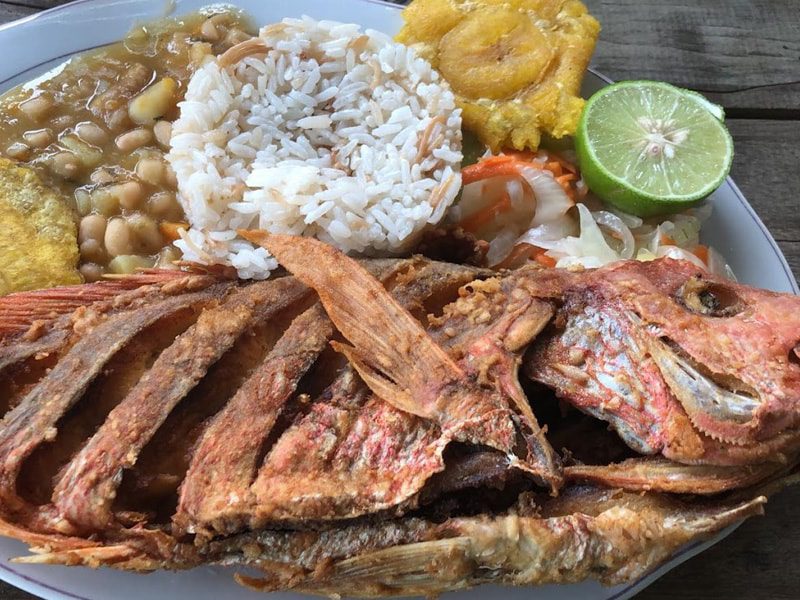
Pescado frito: this regional staple often consists of fried fish accompanied by patacones (fried plantains) and coconut rice. Local fish such as snapper or grouper are the most commonly used.
Arroz con coco: this rice is cooked with coconut milk and sometimes panela for a sweet note, giving it a mild, creamy flavor. It is often served with fish or seafood dishes.
Ceviche de piangua: the ceviche of this region is prepared with pianguas, a local shellfish, marinated in lemon juice with coriander, parsley, onion and olive oil.
Encocado : a creamy stew simmered with coconut milk, garlic, onions and coriander, often prepared with fish or seafood such as shrimps or crabs.
Sancocho de pescado: a thick, nourishing soup made with fish, vegetables such as cassava, plantain and potatoes, and seasoned with local spices.
Viche” drink: viche is a traditional alcoholic beverage from Colombia’s Pacific coast, made by hand from sugar cane. Deeply rooted in Afro-Colombian culture, it is often consumed during festivals, religious ceremonies and rituals. The production process involves extraction of the cane juice, fermentation and distillation in traditional stills. Flavored with local herbs, barks and fruits, viche can take on different forms, such as tumbacatre or arrechón. More than just a drink, viche represents the identity and traditions of Colombia’s Pacific communities.


Tips & notes for your stay at Bahia Solano
Roots adventure: few comforts & difficult climatic conditions
Bahía Solano offers a unique experience, quite different from the Colombian Caribbean coast. However, it’s not for everyone. The heat and high humidity can be taxing, increasing the risk of fatigue. What’s more, Bahía Solano doesn’t meet Western tourist standards. You won’t find any palaces or 4-5 star hotels. Even the most expensive accommodations are mainly wooden cabins or small hotels with basic amenities. Depending on where you stay, access to wifi and electricity may be limited. This trip is truly a return to basics!
Take sufficient cash
As there is only one cash machine in Bahia Solano, which is often empty, it’s crucial to have enough cash on hand before you leave to cover all your expenses during your stay.
Rainy region
Beware, the Chocó Pacific in Colombia is famous for its extremely humid tropical climate, with abundant rainfall all year round. In fact, this region is one of the wettest in the world.
Suitable clothing
Choose comfortable, lightweight, quick-drying clothing. Choose pants and long-sleeved shirts to protect you from the sun and insects. Bring a cap or hat too.
Waterproof bags
Take a few waterproof bags to protect your electronic devices, as both the dry season and the rainy season are wet, and the risk of showers (sometimes heavy) is very real.
Sunscreen + Sunglasses
Temperatures can be very high, and some activities take place in intense sunshine without shelter. Make sure you’re well protected, especially with biodegradable sunscreen.
Personal medications
Check that you have enough medication if you are undergoing a particular treatment, as it is generally difficult to find specific medical facilities in Bahia Solano.
Mosquito repellent
Bring a mosquito repellent containing DEET or IR3535, essential in Chocó where mosquitoes are numerous as soon as you get away from the ocean. Choose a product adapted to tropical zones.
Don’t turn on the lights at night
If you spend the night outside the village, close to nature, to avoid an invasion of insects after dark, avoid turning on your bedroom light. Instead, use the light on your telephone to stay out of harm’s way.


