

In brief


Welcome to the fascinating Tatacoa Desert, ready to be explored! This practical guide is your ideal companion for plunging into the heart of this astonishing place. With its ochre and grey canyons, unique geological formations and breathtaking starry skies, the Tatacoa offers an extraordinary experience. Discover the secrets of this Colombian desert, with essential tips on how to make the most of your stay, whether you want to observe the flora and fauna, venture along its winding trails, or contemplate the Milky Way at night.
Whether you’re an astronomy enthusiast, a nature lover or just an explorer looking for a change of scenery, get ready for an exceptional adventure in this spectacular desert, where every grain of sand tells a story.
Tatacoa Desert
- County: Huila (Andes)
- Area: 330 km2
- Altitude: 386 to 900 m
- Ecosystem: Tropical dry forest
- Climate: Warm semi-arid
- Direct access from Villavieja
- Recommended duration: 1 day and 1 night
Our verdict: a must-see without going out of your way. ★
Forget the sand dunes. The Tatacoa Desert, with its fascinating lunar landscapes and spectacular starry nights, offers a unique experience. Hikes through the desert trails reveal a surprising ecological diversity. However, high daytime temperatures can make exploration demanding, and the lack of a developed tourist infrastructure means that accommodation conditions are fairly basic. Discovering the desert is a good option for itineraries in southern Colombia. In our opinion, there’s no need to incorporate it expressly into another itinerary involving a detour.
When to visit the Tatacoa Desert?
The Tatacoa desert can be visited all year round.
If you’re looking for peace and quiet, opt for weekdays. Also avoid December-January, Holy Week, weekends and public holidays, which are often busier. However, the Tatacoa Desert is not as popular as the Cocora Valley or Tayrona Park, so don’t stress!
Climate in the Tatacoa Desert: the climate in the Tatacoa Desert is warm semi-arid, characterized by high daytime temperatures and relatively cool nights. Daytime temperatures can reach 40 or even 40°c, while nights can be cool, around 17°c. In this part of Colombia, rainfall is generally lower in December, January, February, June and July. These drier periods offer clear skies for clear observation of astronomical phenomena.
Legend: Blue: transport – Yellow: activities & visits – Green: accommodation – Orange: restaurants
Getting to know the Tatacoa desert better
Witness to a remarkable geological evolution, this once lush desert now boasts canyons, cacti and striking ochre hues. Immerse yourself in this unique place, a blend of history, geology and arid, breathtakingly beautiful nature (like the heat of the place!).
Story: sadness and snakes as inspiration
Tatacoa or the Valley of Sadness, as it was called by the conquistador Jiménez de Quesada in 1538, due to the traces of deterioration he had noticed on its territory, is not a desert, but a tropical dry forest. Over time, it was called desert and, in homage to the snake Jararaca, in Spanish Tatacoa, it was christened “Desierto de la Tatacoa” (Desert of the Tatacoa). Its relief is very distinctive, with reddish and ochre dunes in the Cuzco region and grey tones in the Los Hoyos area.
Geography: a desert, really?
Recent studies indicate that during the Miocene, a period ending around five million years ago, this area was a tropical forest. Extremely fertile soil supported a diversity of flowers and trees, before gradually drying out to take the form of the desert landscape we observe today. Climatic variation in the distribution of rainfall and humidity, accentuated by the evolution of the Cordillera Oriental, emerges as one of the main causes of the ecosystem’s upheaval. The formation of a mountain barrier has altered the distribution of precipitation, leading to a reduction in soil moisture.
Tatacoa, classified as Colombia’s second largest arid zone after the Guajira Peninsula, is one of the country’s most captivating natural landscapes. Covering 330 square kilometers, it offers an expanse of ochre and gray earth punctuated by green cacti. The Tatacoa desert is distinguished by its two characteristic hues:ochre in the Cuzco area and grey in the Los Hoyos region.
Characterized by severe erosion, the region is criss-crossed by dry canyons that form temporarily during the “winter” months. These intriguing structures form on clay surfaces, creating labyrinthine ravines up to 20 meters deep in the landscape.
Biodiversity: from fossils to living beings
As you’d expect, this is not the most impressive site in terms of biodiversity. The Tatacoa desert is home to a few species, including rattlesnakes, arachnids such as spiders and scorpions, eagles, lizards and weasels. In the distant past, ocelots also roamed these arid lands.
Characteristic plants include cacti, some of which produce edible red berries, and cottonwoods, which add a distinctive touch to the landscape.
Paleontological finds, including fossils of molluscs, turtles, rodents, armadillos and even giant sloths dating back over 60,000 years, suggest that Tatacoa once had a lush and diverse flora to support such a variety of fauna since the Tertiary and Pleistocene. An archaeological museum in Villavieja, housed in the Santa Barbara chapel, displays many of these captivating fossils.


Visit the Tatacoa desert
The Tatacoa desert is a stunning natural site in the heart of the Colombian Andes, offering an exceptional experience for adventurers in search of originality.
Unlike a conventional desert, Tatacoa surprises with its magnificent red and gray landscapes, resulting from its geological past as a tropical dry forest. Exploring Tatacoa, travelers discover a surreal environment where winding trails wind through natural labyrinths.
The raw beauty of the desert is also revealed at night, offering an ideal setting for stargazing. With its clear, light pollution-free skies, Tatacoa offers the opportunity to explore the galaxy by visiting one of the astronomical observatories dotted around the desert.
Although it is possible to discover the desert on your own, we strongly recommend taking a guide for several reasons:
- A guide can pass on his knowledge of the desert, its history, flora and fauna. There’s more to this desert than meets the eye.
- A guide, unlike you, knows the main trails, but also the paths through the labyrinths. So you can explore the desert in depth.
- For safety reasons: if you’re on your own, you risk getting lost (or not exploring the complex trails known to the guides); and if you feel unwell in the heat, being on your own…
- Supporting the local economy and sharing a good time with Colombians 😊
All of the following can be done in one (big) day.
Don’t forget to take a look at our Google map at the top of the page to see all the points of interest.
AGENCIES AND LOCAL GUIDES
Tour from Bogotá with Ecotrips
Tour from Neiva: Yimmy tours
Guide from Villavieja: Nathan Martinez or ask directly where you’re staying (they all have contacts).

The gray desert (Los Hoyos)
The grey desert, also known as “Los Hoyos” (the pits), seduces with its shades of grey, evoking a lunar world (with a little imagination). The geological formations sculpted by erosion offer a striking picture. This is the area furthest from Villavieja (about 50 minutes by tuk tuk). This place is reminiscent of Turkey’s splendid Cappadocia, so striking were the similarities in natural beauty.
We highly recommend visiting the grey desert at sunset, when the colors take on a spectacular intensity, transforming the landscape into an enchanting tableau.
Offering a less picturesque but equally impressive beauty, the Xylopalos trail unveils itself as an unparalleled experience. A unique view of the desert awaits you before you reach three narrow canyons: El Tiempo, La Señorita and La Culebra. Explore these canyons, shaped by millions of years of rainwater run-off, with depths of no more than three meters.
Along the way, discover a pink cherry-shaped fruit from the cactus, offering an exquisite flavor. At the halfway point, our journey took us to a local goat farm, where a snack break proved essential, especially in the sweltering heat of the day.

The Red Desert (Cuzco Desert)
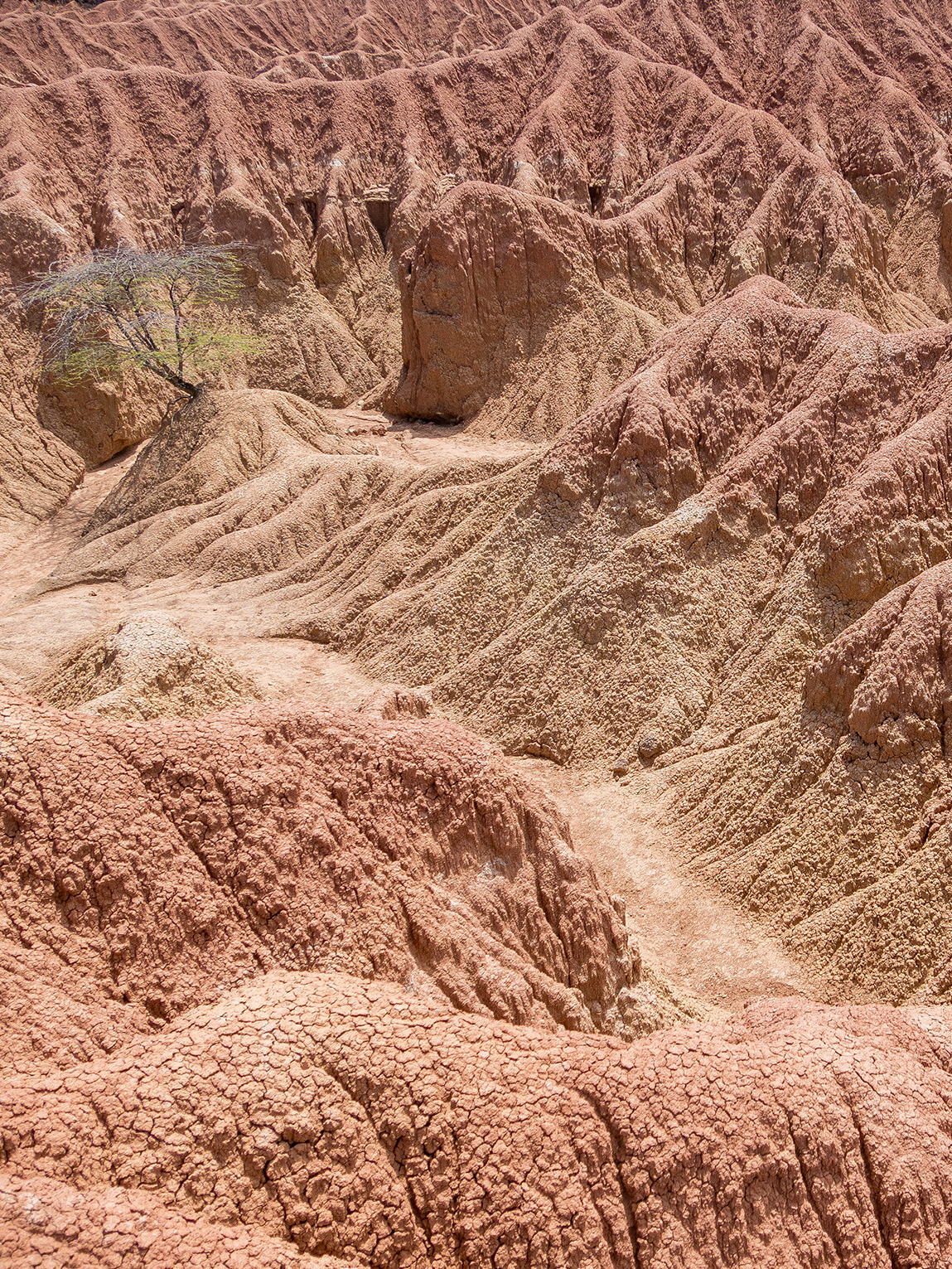
The red desert of La Tatacoa, also known as Cuzco, stands out as the most famous part, adorned with several viewpoints along the road that offer an unreal vision of the landscape. Red hues, resulting from the presence of iron in the soil, give the land ochre, rust and copper tones. Must-see observation points include Mirador El Cuzco and Mirador Laberinto, offering magnificent panoramic views.
After admiring the views, descend into the valley and follow the path through the magnificent labyrinth formed by the undulating ground. It’s like contemplating a pure work of art created by Mother Nature. The trail forms a well-defined loop from here, offering the chance to observe numerous cacti (some even bearing fruit!), brightly-colored birds, scorpions, curious goats and sometimes even snakes. Note that “Tatacoa” means “rattlesnake” in Spanish. The hike takes about 1.5 hours, and is mostly flat.
We recommend walking the trail before noon or at sunset, when temperatures are milder. What’s more, most animals are more active in the morning, offering bird enthusiasts a privileged opportunity.
At the entrance and exit points of the trail, a restaurant serves fresh sugarcane juice, the perfect refreshing drink for recovering after braving the heat of the Tatacoa desert. What’s more, it’s the ideal spot from which to contemplate the entire red desert.

Natural pools
Yes, you read that right! Swimming pools in a desert! The astonishment aroused by the presence of swimming pools in the heart of the Tatacoa desert is explained by the presence of watercourses and underground springs in specific places. Some are crying ecological scandal, while others argue that the water is in a cycle, being drawn off to feed the pools before being released back into the underground springs (though they can’t be sure).
But let’s face it, with the unbearable heat, taking a break and cooling off in one of the 3 pools in the Tatacoa desert is a pure moment of happiness, if not vital.
- Los Hoyos swimming pool (grey desert): this is the best-known and most popular pool.
- Piscine El Manantial (grey desert): less well-known, so less crowded. A good choice.
- Piscine Piscilodo: 1 water pool and 1 mud pool! Not very popular because it’s off the beaten track.

Stargazing
Tatacoa is renowned for its exceptional night skies. Local observatories offer an immersive stargazing experience, unveiling the mysteries of the Milky Way and the constellations.
Visit one of the observatories forenlightening explanations and a bird’s-eye view through one of the six telescopes available. If conditions are ideal, you’ll even be able to see the Milky Way with the naked eye. However, it’s worth noting that the presence of a full moon or clouds can make stargazing particularly difficult.
It’s worth bearing in mind, however, that the observatories in the Tatacoa Desert are nothing like those in Chile’s Atacama Desert. The Colombian sites are much (much) smaller.

Villavieja and the Magdalena river
Although the Tatacoa desert is the main attraction, the village of Villavieja, the gateway to the desert, may be worth a stop if you have enough time (ideally 2 days 1 night for the desert, the village and the Magdalena).
A stroll through the village, with its central square and typical adjacent streets, before enjoying a well-deserved refreshment in a traditional bar/café, is a pleasant experience.
Paleontological Museum: just off the main square, by the Santa Barbara church, you’ll find the Paleontological Museum. It represents a significant venue for enthusiasts of the geological and prehistoric past. Despite its modest size, it houses a rich collection of several hundred fossils, many of which have been unearthed in and around the Tatacoa desert.
Casa del Totumo crafts museum: Casa del Totumo is located in the heart of Villavieja, just 100 metres from the main park. Run by Don Gabriel, it is the place where he designs and exhibits a variety of objects, from emblematic representations of the desert to musical instruments, bedroom furniture, kitchen utensils and animal sculptures. All these items are recreated from Totumo, a tree characteristic of the Tatacoa desert.
Magdalena River cruise: for 25,000 COP per person, you can enjoy a 30-minute boat trip on the Magdalena River, Colombia’s largest river, which meanders close to the town of Villavieja. Despite the brevity of the trip, we were lucky enough to spot many sunbathing turtles and a few iguanas perched in the trees, as well as several species of birds. There’s no set departure time, just go to the pier and they’ll prepare a boat according to demand.
AGENCIES AND LOCAL GUIDES
Tour from Bogotá with Ecotrips
Tour from Neiva: Yimmy tours
Guide from Villavieja: Nathan Martinez or ask directly where you’re staying (they all have contacts).


How to get to the Tatacoa desert?
The village of Villavieja lies on the outskirts of the Tatacoa desert, which serves as the main access point to this arid expanse. This makes Villavieja the ideal place to set down your bag (or suitcase).
Villavieja is regularly served by buses or colectivos from the town of Neiva, capital of the department of Huila. This is theclassic option: go to Neiva, then to Villavieja. A second option, however, is to stop at the village ofAipe, opposite the village of Villavieja, on either side of the Magdalena river.
The nearestairport to the Tatacoa desert is Benito Salas airport in Neiva, served by Avianca, Latam and Clicair from the country’s main cities.
Getting to Villavieja from Neiva
| Companies | Coomotor |
| Departures | Every hour from 05:00 to 18:00 |
| Departure point | Neiva bus terminal |
| Duration | Approx. 1h-1h30 |
| Route type | Direct (no change) |
| Price (one-way) | 8,000 – 10,000 COP / person |
Getting to Villavieja from Aipe
This option only works when you’re coming by bus from the north (e.g. Armenia, Manizales, Bogotá, Medellín, Bucaramanga, etc.) and heading down to the Tatacoa desert. This solution saves around 2-2h30 in travel time (from Neiva to Villavieja).
From the terminal of a town (not a village), buy a ticket for Neiva, but ask the driver to stop at Aipe. Aipe is a village on the banks of the Magdalena River, opposite Villavieja.
- Take a bus to Neiva. Ask the driver to stop at Aipe.
- In Aipe, take a motorcycle cab or cab to the ambarcadero. Motorcycle cab fare: 10,000 COP, 10-minute ride.
- Take a shuttle boat from Aipe to Villavieja. Fare: 5,000 COP, 5-minute trip. Please note that there are no shuttles after 6 p.m.
Getting to Neiva from Armenia, Bogotá, Cali and Medellín
| Departure city | Armenia |
| Companies | Coomotor, Cootranshuila |
| Departures | Every hour from 07:00 to 22:15 |
| Departure point | Armenia bus terminal |
| Duration | 7h |
| Route type | Direct (no change) |
| Price (one-way) | 69,700 – 85,000 COP / person |
| Departure city | Bogotá |
| Companies | Coomotor, Cootranshuila, Lineas Verdes, Bolivariano |
| Departures | Every 15 minutes |
| Departure point | Terminal de Salitre OR terminal del Sur |
| Duration | About 7 hours |
| Route type | Direct (no change) |
| Price (one-way) | 41,000 – 85,000 COP / person |
| Departure city | Cali |
| Companies | Coomotor, Cootranshuila, Flota Magdalena, Bolivariano |
| Departures | Every hour from 05:00 to 21:30 |
| Departure point | Cali bus terminal |
| Duration | Approx. 12-13h |
| Route type | Direct (no change) |
| Price (one-way) | 98,000 – 102,000 COP / person |
| Departure city | Medellín |
| Companies | Coomotor, Flota Magdalena, Bolivariano |
| Departures | Every hour from 05:00 to 22:30 |
| Departure point | Terminal Norte |
| Duration | Approx. 12-2 p.m. |
| Route type | Direct (no change) |
| Price (one-way) | 126,000 – 136,000 COP / person |

Where to stay to visit the Tatacoa desert?
Travellers generally spend 1 day exploring the Tatacoa desert. To make the most of this time, it’s best to stay at least 1 night directly in the desert (often in hut-style accommodation), or in the nearby village of Villavieja (small, simple hotels).
In our opinion, there’s no point in staying in Neiva, apart from wasting time on transport: it’s a good hour’s journey to Villavieja. What’s more, Neiva is not an interesting town at all.
Accomodation in Villavieja

$ – Economical budgeting
Hostal
Casa Hotel Estelar
A small, simple hotel that’s quite modern compared with what’s on offer in Villavieja, and above all for a ridiculously low price, with a swimming pool!

$$ – Average budget
Hotel
Tatacoa Star Eco Hotel
The hotel is partly built of bamboo and other natural materials, with a style all its own. And every room has a terrace.

$$ – Average budget
Hotel
Hotel Colonial Villavieja
Hotel with a beautiful patio and pool, with simple, uncluttered rooms. And the staff are very attentive!
Housing in the desert

$ – Economical budgeting
Guest house
Casa de campo los Cactus
A property located in the heart of the desert, with cabins made from recycled bottles, and for a small price.

$$ – Average budget
Ecolodge
Biohotel Tatacoa Qji
Qji Glamping offers cabins nestled in the heart of the Tatacoa gray desert. Peace and tranquility guaranteed!

$$ – Average budget
Ecolodge
Mana Star Lounge Hotel
Mana Star is well positioned between the gray and red Tatacoa deserts, offering secluded cabins.

Tips for visiting the Tatacoa Desert
Leave early in the morning
To avoid the heat, schedule your desert visit as early as possible.
Low physical effort
Visiting the desert is not physically difficult. It’s generally flat. You’ll just have to deal with the intense heat.
Sun protection
It’s very hot in the desert, and the ultraviolet rays are strong. Take sun cream, a hat and sunglasses with you.
Take a bathing suit!
There are a few (paying) swimming pools in the middle of the desert! And make sure you want to go when it’s 40°C. So pack your bathing suit!
Bring water
Don’t forget to take water with you on your walk. You won’t easily find places to buy it.
Dressing for the sun
Choose light, loose-fitting clothes that allow your skin to breathe. It’s hot, but try to cover up.


